
Paul Smith Porsche 911:
the story behind Stripey
All photographs by Mathieu Bonnevie for Porsche and Paul Smith.
Some Porsche 911s become famous because they win races.
Others because of who owned them.
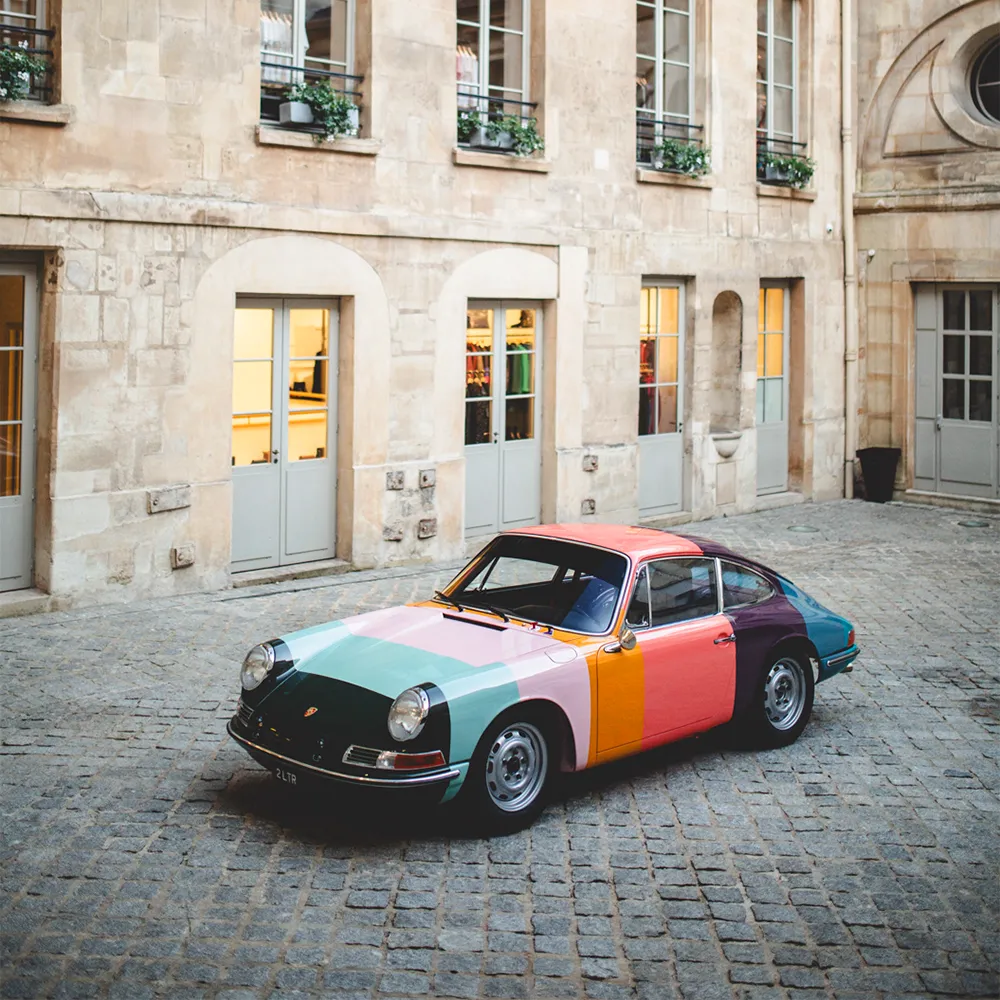
This one became famous because somebody painted almost every visible — and invisible — surface in stripes.
Pink. Green. Orange. Blue. Burgundy.
Colour running over one of the purest shapes Porsche ever made.
It looks almost irreverent.
Which is precisely why it works.
But the Porsche usually described as the Paul Smith 911 has a much better story than the photographs suggest.
It wasn’t a fashion exercise.
It wasn’t built for a motor show.
And despite appearances, it certainly wasn’t created to sit still.
It was built to race.
And eight years after its first appearance at Le Mans, it still does.
The early 911 underneath the stripes
Beneath the colour is not a decorative classic.
The striped car is a 1965 Porsche 911 2.0, one of the early short-wheelbase cars, subsequently prepared for historic competition. Its specification was conceived around the pre-1966 FIA regulations and what would become the 2.0 Litre Cup.
It is a proper racing 911.
Small. Light. Two litres. Short wheelbase. No unnecessary weight.
The kind of early 911 whose apparent simplicity hides one of the most delicate chassis Porsche ever built.
Richard Tuthill himself has described the 1965 short-wheelbase 911 as the Porsche he would choose above any other: small, light, controllable and capable of being driven extremely hard without needing enormous speed to become interesting.
Before the stripes, then, the idea was already pure Porsche.
The idea did not start with Paul Smith
It started with James Turner.
Turner is the co-founder of Sports Purpose, the Porsche specialist based at Bicester Heritage in England, and a long-time Paul Smith admirer.
Not casually.
He remembered buying his first Paul Smith jumper and jeans — and still owning them years later.
Through previous contact with the company he had got to know Marcus Black, then Paul Smith’s Head of Licensing.
The two had originally discussed collaborating on another project.
A bicycle.
That project never became the important one.
The Porsche did.
When Turner decided to build his own historic racing 911 with Richard Tuthill, another thought appeared: why not cover it in Paul Smith’s Artist Stripe?
A very serious Porsche.
Wearing very unserious colours.
The contradiction was perfect.
Turner approached Black.
Black approached Paul Smith.
Apparently, convincing him required little more than a single-page drawing showing the car and proposed colour treatment.
Smith was already a Porsche enthusiast and had owned several 911s.
He said yes.
Six months later, the car was racing at Le Mans.
Paul Smith and cars: this wasn’t his first collision with machinery
The Porsche makes more sense when placed within Paul Smith’s wider relationship with cars.
Smith has always operated somewhere between British restraint and deliberate disruption.
A conventional object.
Then one unexpected detail.
His own description of the approach has often been reduced to a simple idea:
classic, with a twist.
Cars offered an unusually literal canvas for that philosophy.
Before the Porsche came Paul Smith Minis, including the production Mini Paul Smith and the famous one-off car covered in multicoloured stripes.
There was also his interpretation of the Land Rover Defender, together with projects involving Triumph motorcycles and other transport objects.
So covering a Porsche in colour wasn’t a random excursion into automotive culture.
It belonged to a much longer fascination with machines, engineering and the ability of colour to completely alter the perception of a familiar object.
And few automotive forms are more familiar than the 911.
Which makes altering one more dangerous.
Why the early 911 was the perfect canvas
A striped modern supercar is easy.
Its body already shouts.
An early 911 does the opposite.
The 1965 body is remarkably clean.
Narrow. Compact. No enormous air intakes. No wings. No aggressive aero.
No surface trying to compete with another surface.
Almost fragile by modern standards.
Just one continuous shape.
That purity is precisely what allows the colour to become so powerful.
The stripes don’t fight the architecture.
They reveal it.
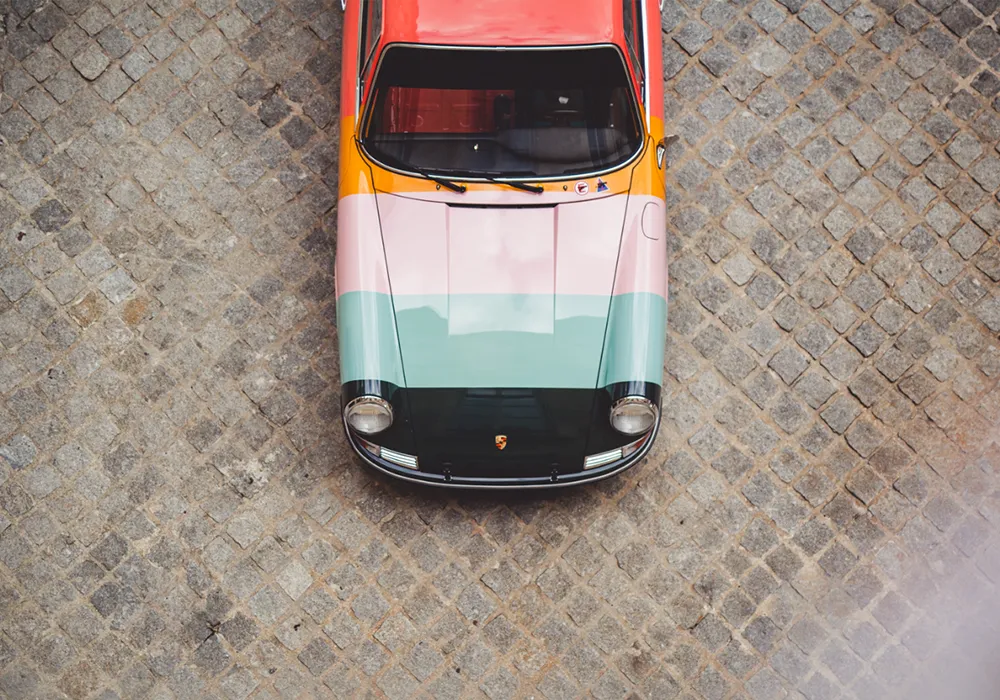
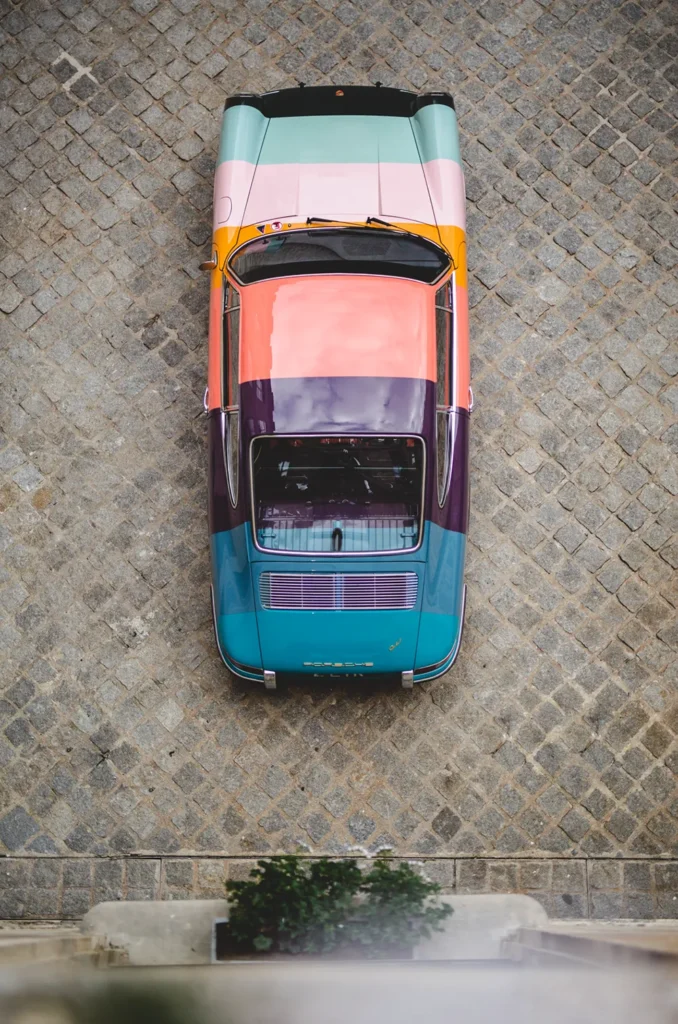
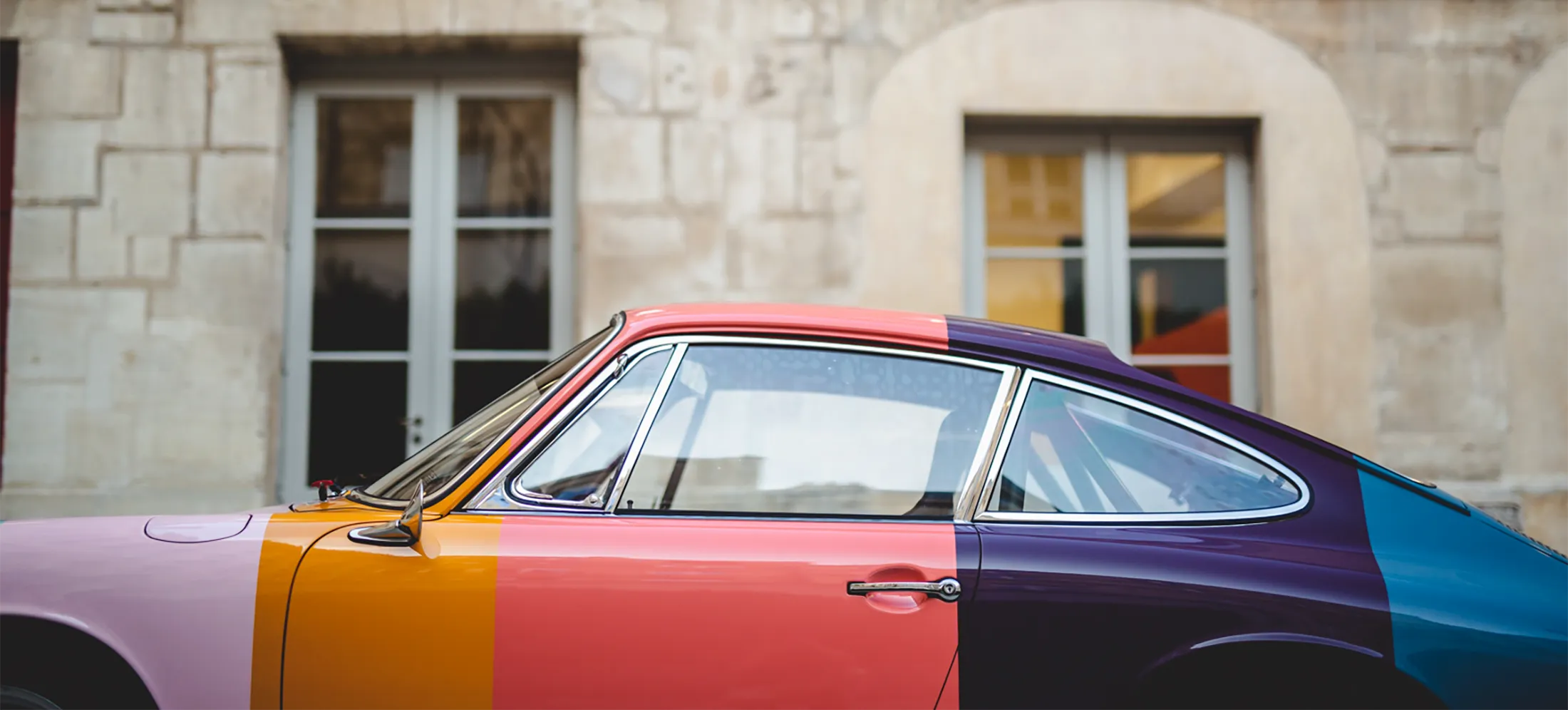
Move from the dark green nose through pale blue, pink, orange, coral, burgundy and turquoise and something unexpected happens:
you begin to read the body differently.
The colour breaks the continuous silhouette into sections.
Front wing. Door. Rear quarter. Roof. Engine cover.
The Porsche becomes almost an exploded diagram of itself.
Except nothing has moved.
Colour has done all the work.
That is perhaps the most interesting part of the entire project.
Paul Smith did not redesign the 911.
He changed the way we look at it.
Then Tuthill discovered that fabric colours don’t behave like paint
This is where the story gets considerably better.
Transferring the Artist Stripe onto a car sounds straightforward.
It wasn’t.
Paul Smith had colour references for textiles and vinyl.
They did not translate directly into automotive paint codes.
There was no convenient set of Pantone numbers that Tuthill Porsche could simply hand to the paint shop.
So the team began mixing.
Testing. Comparing. Adjusting.
And collectively deciding which paint actually looked right.
Eventually, three different types of paint had to be used across the car, each requiring a different application process.
That alone would have complicated the build.
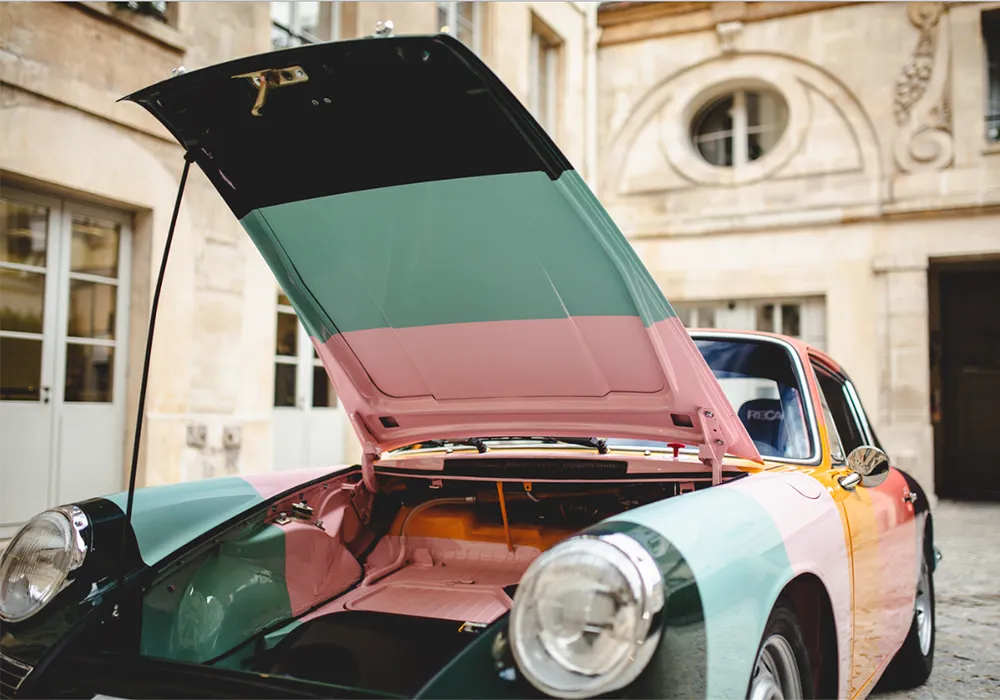
Then somebody decided the stripes shouldn’t stop at the doors.
400 extra hours of paint
Most people would have painted the exterior.
The project team painted the car. All of it.
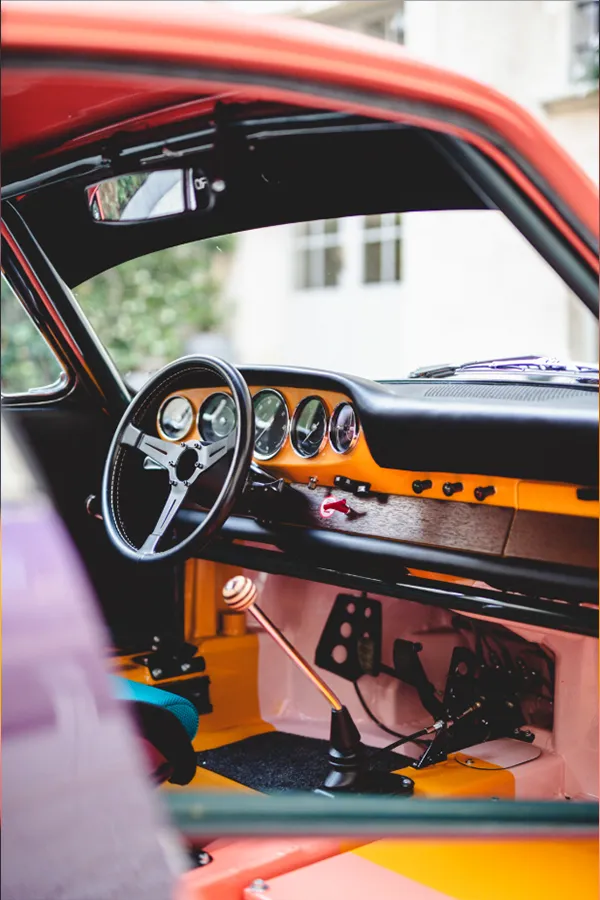
The Artist Stripe continues through the cabin.
Across the floors. Behind panels. And underneath the car.
Areas nobody standing beside it would ever see were aligned with the visible stripes above them.
The back of individual panels was painted correctly.
The ballast box in the passenger footwell follows the colour boundary.
Even the battery strap changes colour halfway across.
Tuthill normally estimated around 200 hours to paint a 911 to its standards.
The Paul Smith treatment added more than 400 additional hours.
More than twice the normal paint labour.
For a racing car.
The absurdity is magnificent.
And fundamentally Porsche-like.
Because if something is going to be done, the fact that nobody can see it is not necessarily an argument for doing it badly.
At one point Richard Tuthill summed up the problem perfectly: once they had started, they simply couldn’t stop.
That may be the most important detail in the whole car.
Not the colours.
The obsession.
Even the roll cage became part of the composition
A racing cockpit introduces problems that fashion normally doesn’t.
You need a roll cage. A seat. Harnesses. Battery equipment. Ballast.
Things dictated by safety and function rather than composition.
A conventional black cage would have cut straight through the palette.
So Marcus Black proposed something else.
Paint it in the same dark green used on the nose.
The racing seat received a petrol-blue cushion.
The stripped cabin allowed the coloured body itself to remain visible around everything else.
Nothing was disguised.
It remained obviously a competition car.
But every functional element was forced to negotiate with the visual system.
Engineering first.
Colour around it.
Exactly as it should be.
And then there is the gear knob
Small details make strange objects memorable.
This one has a particularly good one.
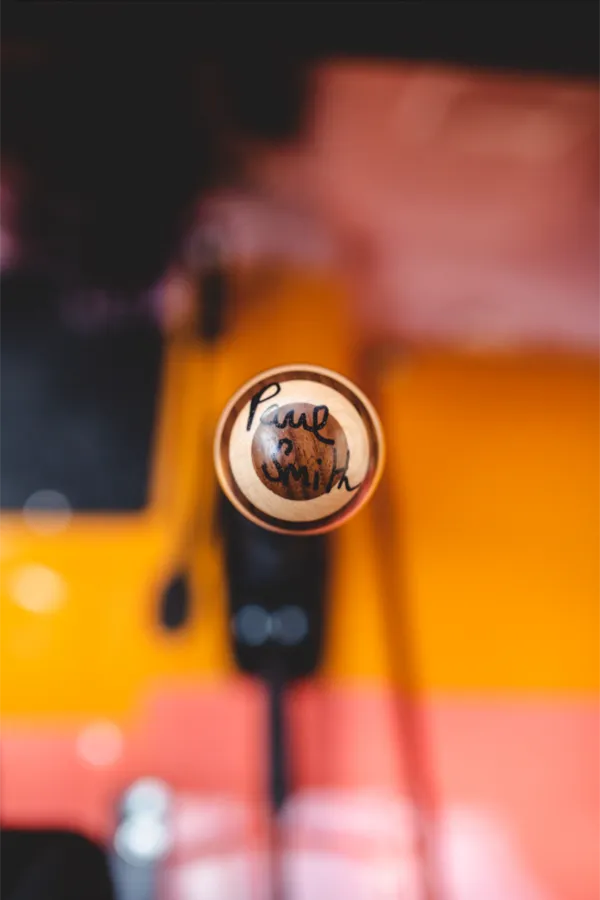
The gear lever is topped with a wooden knob inspired by the Porsche 917.
That reference is not decorative mythology.
Porsche famously used lightweight wood for the gear knob of the 917 as part of its obsessive approach to weight saving.
On Stripey, the wooden knob carries Paul Smith’s signature.
German racing pragmatism.
British fashion.
Separated by about five centimetres.
There is also the registration plate: 2 LTR.
Another small joke with a serious background.
The 2.0 Litre Cup
The car was originally conceived around a new historic racing series Turner was helping create.
The idea was beautifully narrow: early short-wheelbase Porsche 911s.
Two-litre engines. Pre-1966 specification. Nothing else.
The 2.0 Litre Cup was established through Turner together with Tuthill Porsche, Maxted-Page, Historika and Peter Auto.
No GT3s. No Turbos. No gigantic tyres.
Just the earliest expression of the 911 as a competition car.
It is important because it explains why Stripey isn’t merely an old Porsche wearing a racing costume.
It was built for this environment.
The colour came afterwards.
The racing purpose came first.
Le Mans before the paint was barely dry
Most art cars make their debut beneath lights.
Stripey made hers at Le Mans.
The engine had been run in by Tuthill in another car.
Once installed, Richard Tuthill drove the completed Paul Smith Porsche for only around 10 miles before it was taken to France.
Then it raced.
Its first competitive appearance came in the Porsche Classic Race at the 2018 Le Mans Classic, part of Porsche’s 70th-anniversary celebrations.
James Turner finished 27th from 68 starters.
The car ran faultlessly for more than two hours of racing.
Turner’s explanation for not pushing harder was considerably less heroic.
He wanted to take his son to school in it a few days later.
That single comment tells you almost everything about the car.
Race at Le Mans on Sunday.
School run on Wednesday.
Then Goodwood
A few days later came the 2018 Goodwood Festival of Speed.
Stripey climbed the hill driven not only by Turner, but also by Richard Tuthill, Marcus Black and Charlie Settrington, now the Duke of Richmond and Gordon. Sports Purpose still recalls those runs as part of the car’s history.
There is even a small piece of mythology attached to them.
A video known as The World’s Fastest Rainbow circulated showing the 911 being driven very seriously up the Goodwood hill.
For years the drive was attributed to Turner.
It wasn’t him.
According to Turner himself, the man behind the wheel was Richard Tuthill.
Which perhaps explains the commitment.
From the Festival of Speed to the pub
And this is where the story stops behaving like the story of an art car.
After the final runs at Goodwood, Turner got into Stripey and simply drove away.
Out of the paddock.
Onto the road.
Towards a pub.
On the way, Classic Driver persuaded the group to sneak briefly onto the Goodwood Motor Circuit for photographs and what was described — with appropriate suspicion — as a slow lap or two.
Then they carried on to the pub.
No transporter.
No velvet rope.
No climate-controlled museum.
A 1965 racing 911 covered in several hundred hours of bespoke paintwork, driven away after a hillclimb for a beer.
That is arguably what saves the entire project.
Because without use, the stripes risk becoming precious.
With scars, heat and racing kilometres, they become part of the car.
Not everyone loved it
James Turner did.
Paul Smith did.
The internet did.
Mostly.
When photographs of the car appeared in 2018, they spread rapidly enough that Porsche itself shared them, and Turner later said the car generated the most-liked photograph on Paul Smith’s Instagram account at the time.
But not everybody approved.
Turner was pleased about that too.
He specifically said he liked the fact that some people didn’t love it.
And he’s right.
A 1965 Porsche 911 occupies dangerous territory.
Originality matters. Purity matters.
People have opinions about the wrong screws.
Cover one in pink and turquoise stripes and disagreement isn’t a side effect. It is inevitable.
But a design that everybody finds acceptable rarely changes anything.
Stripey did.
It never became a museum piece
The easiest ending to this story would be 2018.
Le Mans. Goodwood. Instagram fame. Car retired. Story complete.
Except that isn’t what happened.
Sports Purpose still identifies James Turner as the owner of the Paul Smith 911, and over the following years Stripey continued appearing in historic motorsport. It has competed at Goodwood, where an engine problem once left it 28th after qualifying before Tuthill installed another engine overnight so the car could race again.
The paint has not turned it into something sacred.
It remains what it was built to be.
A racing car.
And then, in 2026, the story gained another chapter.
Eight years later: Emanuele Pirro gets in
At the opening round of the 2026 Le Mans Classic Series at Barcelona, Stripey returned to the 2.0 Litre Cup.
This time James Turner shared it with a driver who knows something about Le Mans.
Emanuele Pirro.
Five-time overall winner of the 24 Hours.
The race was disrupted by a full-course yellow that scrambled much of the order, and Pirro eventually finished eighth in the striped 911.
The result is almost irrelevant.
What matters is the image.
A 1965 short-wheelbase 911.
Painted in Paul Smith stripes in 2018.
Still racing in 2026.
Now with a five-time Le Mans winner behind the wheel.
That is not the normal life expectancy of a fashion collaboration.
And that may be why Stripey has aged so well.
Paul Smith didn’t change the 911
Perhaps the cleverest thing about Stripey is that beneath all that colour, the original shape remains untouched.
Nothing competes with the silhouette.
Nothing tries to modernise it.
Nothing attempts to improve Ferdinand Alexander Porsche’s lines.
The intervention exists entirely on the surface.
And yet the car becomes completely different.
That requires confidence.
Because reinterpretation often begins by adding.
Wider bodywork. Different lights. Different wheels. More aggression.
Paul Smith added almost nothing.
Just colour. A lot of it.
The 911 did the rest.
The world’s fastest rainbow
There is a temptation with cars like this to talk about them as if they were fragile cultural objects.
Stripey refuses.
It has raced at Le Mans.
Climbed Goodwood.
Broken engines.
Had engines replaced overnight.
Driven on public roads.
Gone to the pub.
Returned to competition.
And in 2026, Emanuele Pirro raced it.
The paint underneath is extraordinarily precise.
The life above it isn’t.
And perhaps that is why this particular 911 feels so right.
Precision underneath.
Instinct on top.
A serious racing car wearing colours that refuse to behave seriously.
Paul Smith didn’t turn a Porsche into fashion.
He helped reveal something already inside the 911: that purity doesn’t have to mean conformity.
Sometimes it can be green. Pink. Orange. Blue.
And travelling very quickly indeed.
Why this car matters
There have been more famous Porsche art cars.
Some were created by internationally recognised artists.
Others raced at Le Mans with factory backing.
Stripey belongs somewhere slightly different.
It wasn’t commissioned by Porsche.
It wasn’t designed to commemorate an anniversary.
It wasn’t created primarily for exhibition.
It happened because a Porsche obsessive who loved Paul Smith asked a simple question:
What if?
Then a fashion designer said yes.
A Porsche racing specialist had to work out how to make it real.
And everybody involved became slightly obsessed with doing it properly.
The result is difficult to categorise.
Fashion object? Race car? Art car? Historic 911?
Probably all four.
But none quite explains it.

The shape was already iconic.
Colour changed the way we saw it.
Discover our interpretation of the Paul Smith 911, a limited-edition work inspired by the collision of heritage, colour and irreverence.